Source 3 channel veterinary ecg machine for clinics, hospitals, and surgeries
Find and compare 30 listings of the 3 channel veterinary ecg machine from verified Chinese suppliers. Buyers can review specifications, pricing, and certifications for veterinary surgery applications in clinics and hospitals.
Key considerations
Products List


Comprehensive Sourcing Guide
Strategic Sourcing Guide for 3-Channel Veterinary ECG Machines
The veterinary medical equipment market has seen a significant shift toward advanced diagnostic tools that bridge the gap between human and animal healthcare. Among these, the 3-channel veterinary ECG machine represents a critical entry point for clinics seeking reliable cardiac monitoring without the immediate capital expenditure of high-end 12-lead systems. For procurement officers and veterinary practice managers, sourcing these devices requires a disciplined approach that balances technical capability, regulatory compliance, and total cost of ownership. This guide outlines the essential factors for evaluating suppliers and selecting equipment that meets the rigorous demands of veterinary surgery and general practice.
Technical Specifications and Signal Integrity
When evaluating a 3-channel ECG machine, the primary focus must be on signal fidelity and channel configuration. Unlike human ECGs, veterinary applications often involve species with varying heart rates and body sizes, from small felines to large canines. The core specification to verify is the sampling rate, which determines the resolution of the electrical signal. High-quality units in this category typically feature sampling rates around 8000Hz (1ms), ensuring that rapid cardiac events are captured accurately. The frequency response is equally critical; a standard range of 0.05 to 150Hz (-3dB) is generally expected to capture both low-frequency ST-segment changes and high-frequency QRS complexes without distortion.
Buyers must also scrutinize the Common Mode Rejection Ratio (CMRR), a measure of the device's ability to reject noise from the environment. A CMRR greater than 100dB is a robust benchmark for clinical-grade equipment, ensuring that muscle artifacts and electromagnetic interference do not obscure the cardiac waveform. Additionally, the time constant, which affects the baseline stability of the tracing, should be verified to be at least 3.2 seconds. This specification is vital for preventing baseline wander, a common issue in moving animal patients.
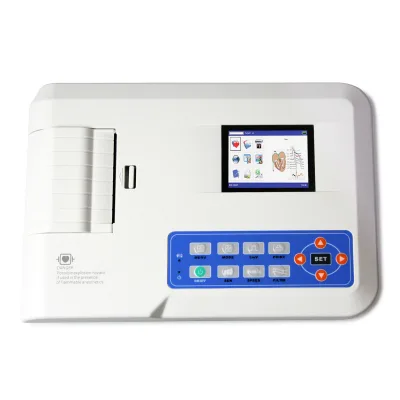
The display interface is another technical differentiator. Modern units often incorporate 7-inch LCD color screens or 7-inch touch screens, providing sufficient real estate for viewing multi-lead tracings simultaneously. While some models may feature 5-inch displays, the larger screen size enhances readability in a busy surgical setting. The conversion resolution, often cited as 12-bit in advanced models, ensures that the analog signal is digitized with high precision, minimizing quantization errors. It is important to note that while some product listings mention "12-bit" conversion, buyers should confirm this specific attribute for the exact model number, as lower-cost alternatives may utilize 10-bit or 11-bit converters.
Regulatory Compliance and Certification Standards
Navigating the regulatory landscape is a non-negotiable aspect of B2B procurement for medical devices. Veterinary ECG machines are classified as physiological diagnostic and monitoring equipment, and their certification status dictates their marketability and safety. Buyers should prioritize suppliers who can provide documentation for recognized international standards. Common certifications observed in the sector include ISO, CE, and FDA approvals. For instance, some models carry certifications under the classification of "Physiological Functions of Diagnosis and Monitoring Equipment," while others may be listed under "Imaging Diagnostic Equipment," though the latter is less common for pure ECG units.
The specific standard codes, such as ISO 13485 for quality management or IEC 60601-1 for electrical safety, are critical verification points. A product listing might state "CE, ISO" or "FDA, ISO, MSDS, EEC," but the buyer must request the actual certificate numbers and validity dates. It is also essential to verify if the device meets the specific safety requirements for patient leakage current, which should typically be less than 10µA to ensure the safety of the animal patient.
Furthermore, the classification of the device often influences the import requirements in the destination country. In China, products originating from provinces like Jiangsu or Guangdong may have different export compliance profiles. Buyers should confirm that the supplier's certifications are current and applicable to the specific model being purchased, as certifications are often model-specific rather than brand-wide.
Cost Drivers and Pricing Dynamics
The pricing of veterinary ECG machines is influenced by a complex interplay of factors, including channel count, display technology, battery capacity, and certification levels. Market observations indicate a wide price range, with units ranging from approximately $99 to $1599 USD. This variance reflects differences in build quality, feature sets, and the level of after-sales support included. Lower-priced units may offer basic 3-channel functionality with a smaller display and standard battery life, while premium models might include advanced features like 12-bit conversion, larger touch screens, and extended warranty periods.
The Minimum Order Quantity (MOQ) is another significant cost driver. Suppliers often set MOQs between 1 and 10 units, allowing small clinics to purchase single items while offering bulk discounts for larger veterinary chains. The "Selling Units" designation, often listed as "Single item," suggests flexibility for individual purchases, but buyers should negotiate volume pricing for multiple units.
Supply ability is a crucial metric for budgeting and timeline planning. A supplier with a stated supply ability of 1000 units per month can generally accommodate large orders without significant delays. However, buyers must also consider the "Packaging Details," such as standard export cartons, which can impact shipping costs and the risk of damage during transit. Customization options, such as specific branding or software configurations, may also add to the unit cost but can be valuable for large chains seeking uniformity across their facilities.
Typical Applications and Clinical Utility
The primary application for 3-channel veterinary ECG machines is veterinary surgery and general clinical diagnostics. These devices are indispensable for pre-anesthetic screening, where assessing cardiac function is vital to minimize anesthesia risks. The ability to monitor heart rate and rhythm in real-time allows veterinarians to detect arrhythmias, ischemia, and other cardiac anomalies before and during procedures.
The "Usage" category typically includes hospitals and clinics, indicating that these machines are designed for professional, high-volume environments rather than home use. The "Application" field often specifies "Veterinary Surgery," highlighting the device's role in the operating theater. In this setting, the reliability of the device is paramount; a failure to capture a critical event could have life-threatening consequences for the animal.
The 3-channel configuration is particularly useful for screening purposes. While a 12-lead ECG provides a comprehensive map of the heart's electrical activity, a 3-lead system offers a cost-effective solution for monitoring heart rate and basic rhythm disturbances. For many veterinary practices, this level of detail is sufficient for routine check-ups and surgical monitoring. However, for complex cases requiring detailed localization of cardiac issues, the ability to upgrade to a 12-lead system or a higher-channel model may be a consideration for future procurement.
Supplier Evaluation and Operational Reliability
Selecting the right supplier is as important as selecting the right machine. Buyers should evaluate potential partners based on their "After-Sale Service" capabilities, with "Online Technical Support" being a common offering. In the event of a malfunction or the need for software updates, responsive support is essential to minimize downtime. The "Warranty" period is another key indicator of supplier confidence; while some models offer 18 months of coverage, others may provide only 1 year. Buyers should carefully review the terms of the warranty, including what is covered and the process for claims.
The "Port of dispatch" is a logistical factor that affects lead times and shipping costs. Major ports such as Shanghai, Ningbo, and Tianjin are common dispatch points for Chinese manufacturers. Buyers should calculate the total landed cost, including freight and insurance, based on the specific port of origin. Additionally, the "Lead" time, often described as "standard," should be clarified with the supplier to ensure it aligns with project timelines.
Customization capabilities are also a differentiator. Some suppliers offer "Customized" options, allowing for branding or specific feature sets. This is particularly relevant for large veterinary networks that require uniform equipment across multiple locations. The "Product Name" and "Brand Name" should be verified to ensure the supplier is the original manufacturer or an authorized distributor, reducing the risk of counterfeit or substandard products.
Quality Control and Long-Term Procurement Considerations
Ensuring the quality of the ECG machine requires a proactive approach to quality control. Buyers should request test reports and performance data that verify the device's adherence to the stated specifications, such as the 100Hz A/D frequency or the 7-inch screen resolution. While specific test results are not always publicly listed, suppliers should be willing to provide documentation upon request. The "Standard Export Package" mentioned in product details suggests a baseline for packaging quality, but buyers should verify if additional protective measures are available for fragile components.
Long-term procurement considerations include the availability of spare parts and consumables. A device with a "Built-in Battery" requires periodic replacement, and the cost and availability of these batteries should be factored into the total cost of ownership. The "Model Number," such as WT-300G, VECG-32B, or HE-03H, serves as a unique identifier for ordering replacements and accessing technical documentation.
Finally, buyers should consider the scalability of their procurement strategy. As a veterinary practice grows, the need for more advanced diagnostic tools may arise. Choosing a supplier that offers a range of models, from basic 3-channel units to advanced 12-lead systems, can simplify the supply chain and ensure compatibility across the practice's equipment inventory. By focusing on technical specifications, compliance, and supplier reliability, buyers can make informed decisions that enhance patient care and operational efficiency.
FAQs
What is the sampling rate for 3 channel veterinary ecg machine?
The sampling rate is typically 8000Hz with a 1ms resolution. This ensures accurate capture of rapid cardiac events in various animal species during veterinary surgery procedures.
Which certifications are required for veterinary ecg machines?
Common certifications include ISO, CE, and FDA approvals. These verify compliance with physiological diagnostic equipment standards and ensure electrical safety for animal patients.
How long is the warranty period for these devices?
Warranty periods range from 1 year to 18 months depending on the model. Buyers should verify specific terms with the supplier to ensure adequate coverage for clinical use.
Can I find 3 channel veterinary ecg machine with a 7 inch screen?
Yes, many models feature a 7-inch LCD color screen or touch screen. This display size enhances readability for viewing multi-lead tracings in busy surgical settings.
What is the minimum order quantity for these machines?
The minimum order quantity ranges from 1 to 10 units. This flexibility allows small clinics to purchase single items while larger chains can negotiate bulk discounts.
Which power supply mode is standard for portable units?
Built-in battery power supply is a standard feature for portable units. This allows for continuous operation during procedures without reliance on external power sources.
How does the CMRR affect signal quality in veterinary ecg?
A CMRR greater than 100dB ensures robust noise rejection from the environment. This prevents muscle artifacts and electromagnetic interference from obscuring the cardiac waveform during monitoring.